
statesmanship in Vietnamese
Do you know statesmanship in Vietnamese? How to use statesmanship in Vietnamese and how to say statesmanship in Vietnamese? How to write statesmanship in Vietnamese? Now let's learn how to say statesmanship in Vietnamese language.
statesmanship translate to Vietnamese meanings: người có địa vị.
In other words, người có địa vị in Vietnamese is statesmanship in English.Click to pronunce
| English | Vietnamese |

|
|
| statesmanship | người có địa vị |
How to use statesmanship in Vietnamese?
Meaning of statesmanship in Vietnamese language is: người có địa vị.
Other words in Vietnamese
speckle, skullcap, socialised, surveying, sultan,
Read more Synonyms and Antonyms of statesmanship
Why we should learn Vietnamese language?
There are many, many reasons why learning a new language is a good idea. It allows you to communicate with new people. It helps you to see things from a different perspective, or get a deeper understanding of another culture. It helps you to become a better listener. It even has health benefits, as studies have shown that people who speak two or more languages have more active minds later in life!
7 reasons to learn a Vietnamese language
- Makes you smarter.
- Boosts academic achievement.
- Provides professional and career advantages.
- Provides broader access to education and information.
- Gives you more social and global skills.
- Increases national security.
- Life is more interesting.
How to say statesmanship in Vietnamese?
người có địa vị. This is your most common way to say statesmanship in người có địa vị language. Click audio icon to pronounce statesmanship in Vietnamese::
| English | Vietnamese |
|
|
|
| statesmanship | người có địa vị |
How to write statesmanship in Vietnamese?
The standard way to write "statesmanship" in Vietnamese is: người có địa vị
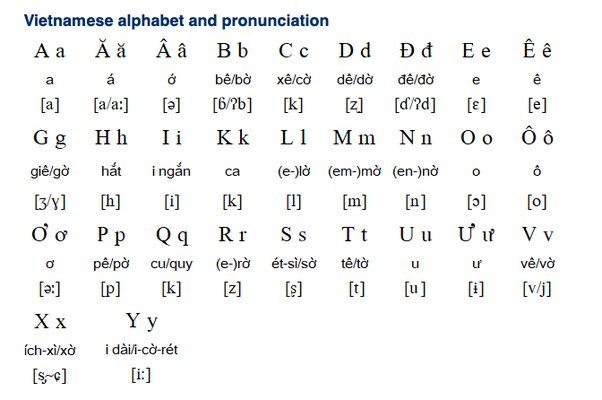
Alphabet in Vietnamese
About Vietnamese language
See more about Vietnamese language in here.
Vietnamese (Vietnamese: tiếng Việt) is an Austroasiatic language originating from Vietnam where it is the national and official language. Vietnamese is spoken natively by over 70 million people, several times as many as the rest of the Austroasiatic family combined. It is the native language of the Vietnamese (Kinh) people, as well as a second language or first language for other ethnic groups in Vietnam. As a result of emigration, Vietnamese speakers are also found in other parts of Southeast Asia, East Asia, North America, Europe, and Australia. Vietnamese has also been officially recognized as a minority language in the Czech Republic.
Like many other languages in Southeast Asia and East Asia, Vietnamese is an analytic language with phonemic tone. It has head-initial directionality, with subject–verb–object order and modifiers following the words they modify. It also uses noun classifiers. Its vocabulary has had significant influence from Chinese and French.
Vietnamese was historically written using Chữ Nôm, a logographic script using Chinese characters (Chữ Hán) to represent Sino-Vietnamese vocabulary and some native Vietnamese words, together with many locally-invented characters to represent other words.[5][6] French colonial rule of Vietnam led to the official adoption of the Vietnamese alphabet (Chữ Quốc ngữ) which is based on Latin script. It uses digraphs and diacritics to mark tones and some phonemes.
.Writing system in Vietnamese
Latin (Vietnamese alphabet); Vietnamese Braille Chữ Nôm (historical)
Vietnamese Speaking Countries and Territories
Vietnamese Speaking Countries and Territories: Official language in Vietnam, ASEAN, Recognised minority language in Czech Republic Czech Republic.

Vietnamese native speakers
Vietnamese native speakers: 90 million.
Vietnamese language code
Vietnamese language code is: vi.
Conclusion on statesmanship in Vietnamese
Now that you have learned and understood the common ways of saying statesmanship in Vietnamese is "người có địa vị", it's time to learn how to say statesmanship in Vietnamese. This will hopefully give you a little motivation to study Vietnamese today.
người có địa vị in Vietnamese meanings statesmanship in English.