
forebears in Vietnamese
Do you know forebears in Vietnamese? How to use forebears in Vietnamese and how to say forebears in Vietnamese? How to write forebears in Vietnamese? Now let's learn how to say forebears in Vietnamese language.
forebears translate to Vietnamese meanings: các bậc tiền bối.
In other words, các bậc tiền bối in Vietnamese is forebears in English.Click to pronunce
| English | Vietnamese |

|
|
| forebears | các bậc tiền bối |
How to use forebears in Vietnamese?
Meaning of forebears in Vietnamese language is: các bậc tiền bối.
Other words in Vietnamese
fondness, Frenchman, fretted, folly, fearfully,
Read more Synonyms and Antonyms of forebears
Why we should learn Vietnamese language?
There are many, many reasons why learning a new language is a good idea. It allows you to communicate with new people. It helps you to see things from a different perspective, or get a deeper understanding of another culture. It helps you to become a better listener. It even has health benefits, as studies have shown that people who speak two or more languages have more active minds later in life!
7 reasons to learn a Vietnamese language
- Makes you smarter.
- Boosts academic achievement.
- Provides professional and career advantages.
- Provides broader access to education and information.
- Gives you more social and global skills.
- Increases national security.
- Life is more interesting.
How to say forebears in Vietnamese?
các bậc tiền bối. This is your most common way to say forebears in các bậc tiền bối language. Click audio icon to pronounce forebears in Vietnamese::
| English | Vietnamese |
|
|
|
| forebears | các bậc tiền bối |
How to write forebears in Vietnamese?
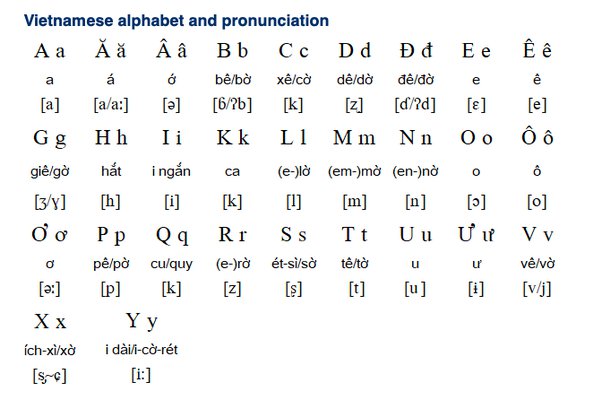
The standard way to write "forebears" in Vietnamese is: các bậc tiền bối
Alphabet in Vietnamese
About Vietnamese language
See more about Vietnamese language in here.
Vietnamese (Vietnamese: tiếng Việt) is an Austroasiatic language originating from Vietnam where it is the national and official language. Vietnamese is spoken natively by over 70 million people, several times as many as the rest of the Austroasiatic family combined. It is the native language of the Vietnamese (Kinh) people, as well as a second language or first language for other ethnic groups in Vietnam. As a result of emigration, Vietnamese speakers are also found in other parts of Southeast Asia, East Asia, North America, Europe, and Australia. Vietnamese has also been officially recognized as a minority language in the Czech Republic.
Like many other languages in Southeast Asia and East Asia, Vietnamese is an analytic language with phonemic tone. It has head-initial directionality, with subject–verb–object order and modifiers following the words they modify. It also uses noun classifiers. Its vocabulary has had significant influence from Chinese and French.
Vietnamese was historically written using Chữ Nôm, a logographic script using Chinese characters (Chữ Hán) to represent Sino-Vietnamese vocabulary and some native Vietnamese words, together with many locally-invented characters to represent other words.[5][6] French colonial rule of Vietnam led to the official adoption of the Vietnamese alphabet (Chữ Quốc ngữ) which is based on Latin script. It uses digraphs and diacritics to mark tones and some phonemes.
.Writing system in Vietnamese
Latin (Vietnamese alphabet); Vietnamese Braille Chữ Nôm (historical)
Vietnamese Speaking Countries and Territories
Vietnamese Speaking Countries and Territories: Official language in Vietnam, ASEAN, Recognised minority language in Czech Republic Czech Republic.

Vietnamese native speakers
Vietnamese native speakers: 90 million.
Vietnamese language code
Vietnamese language code is: vi.
Conclusion on forebears in Vietnamese
Now that you have learned and understood the common ways of saying forebears in Vietnamese is "các bậc tiền bối", it's time to learn how to say forebears in Vietnamese. This will hopefully give you a little motivation to study Vietnamese today.
các bậc tiền bối in Vietnamese meanings forebears in English.