
invitee in Macedonian
Do you know invitee in Macedonian? How to use invitee in Macedonian and how to say invitee in Macedonian? How to write invitee in Macedonian? Now let's learn how to say invitee in Macedonian language.
invitee translate to Macedonian meanings: поканети лица.
In other words, поканети лица in Macedonian is invitee in English.Click to pronunce
| English | Macedonian |

|
|
| invitee | поканети лица |
How to use invitee in Macedonian?
Meaning of invitee in Macedonian language is: поканети лица.
Other words in Macedonian
Icelandic, incompatible with, in all directions, in accord, ill-bred,
Read more Synonyms and Antonyms of invitee
Why we should learn Macedonian language?
There are many, many reasons why learning a new language is a good idea. It allows you to communicate with new people. It helps you to see things from a different perspective, or get a deeper understanding of another culture. It helps you to become a better listener. It even has health benefits, as studies have shown that people who speak two or more languages have more active minds later in life!
7 reasons to learn a Macedonian language
- Makes you smarter.
- Boosts academic achievement.
- Provides professional and career advantages.
- Provides broader access to education and information.
- Gives you more social and global skills.
- Increases national security.
- Life is more interesting.
How to say invitee in Macedonian?
поканети лица. This is your most common way to say invitee in поканети лица language. Click audio icon to pronounce invitee in Macedonian::
| English | Macedonian |
|
|
|
| invitee | поканети лица |
How to write invitee in Macedonian?
The standard way to write "invitee" in Macedonian is: поканети лица
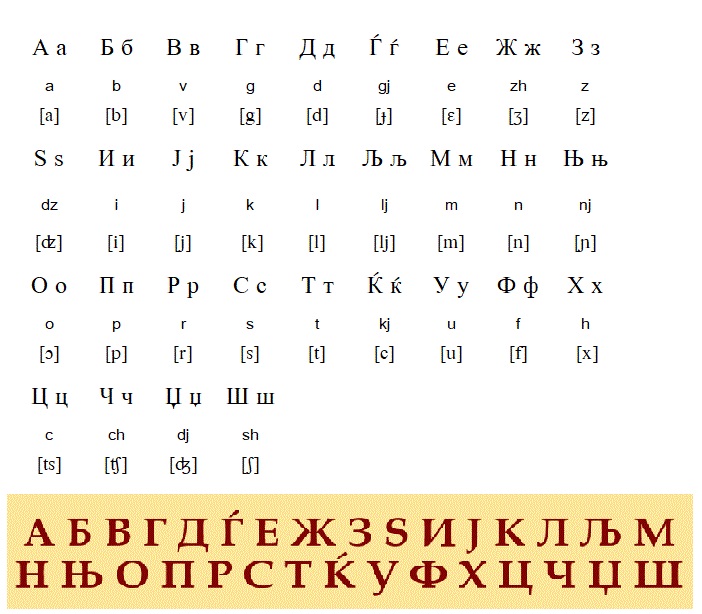
Alphabet in Macedonian
About Macedonian language
See more about Macedonian language in here.
Macedonian (/ˌmæsɪˈdoʊniən/; македонски јазик, translit. makedonski jazik, pronounced [maˈkɛdɔnski ˈjazik] (listen)) is an Eastern South Slavic language. It is part of the Indo-European language family, and is one of the Slavic languages, which are part of a larger Balto-Slavic branch. Spoken as a first language by around two million people, it serves as the official language of North Macedonia. Most speakers can be found in the country and its diaspora, with a smaller number of speakers throughout the transnational region of Macedonia. Macedonian is also a recognized minority language in parts of Albania, Bosnia and Herzegovina, Romania, and Serbia and it is spoken by emigrant communities predominantly in Australia, Canada and the United States.
Macedonian developed out of the western dialects of the East South Slavic dialect continuum, whose earliest recorded form is Old Church Slavonic. During much of its history, this dialect continuum was called "Bulgarian", although in the 19th century, its western dialects came to be known separately as "Macedonian". Standard Macedonian was codified in 1945 and has developed modern literature since. As it is part of a dialect continuum with other South Slavic languages, Macedonian has a high degree of mutual intelligibility with Bulgarian and varieties of Serbo-Croatian.
Linguists distinguish 29 dialects of Macedonian, with linguistic differences separating Western and Eastern groups of dialects. Some features of Macedonian grammar are the use of a dynamic stress that falls on the ante-penultimate syllable, three suffixed deictic articles that indicate noun position in reference to the speaker and the use of simple and complex verb tenses. Macedonian orthography is phonemic with a correspondence of one grapheme per phoneme. It is written using an adapted 31-letter version of the Cyrillic script with six original letters. Macedonian syntax is of the subject-verb-object (SVO) type and has flexible word order.
acedonian vocabulary has been historically influenced by Turkish and Russian. Somewhat less prominent vocabulary influences also came from neighboring and prestige languages. The international consensus outside of Bulgaria is that Macedonian is an autonomous language within the Eastern South Slavic dialect continuum, although since Macedonian and Bulgarian are mutually intelligible and are socio-historically related, a small minority of linguists are divided in their views of the two as separate languages or as a single pluricentric language.
.Writing system in Macedonian
Writing system Cyrillic (Macedonian alphabet), Macedonian Braille
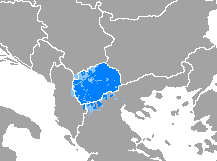
Macedonian Speaking Countries and Territories
Macedonian Speaking Countries and Territories: Official language in North Macedonia. Recognised minority language in Albania Bosnia and Herzegovina, Romania, Serbia..
Macedonian native speakers
Macedonian native speakers: 1.4–3.5 million (1999–2011).
Macedonian language code
Macedonian language code is: mk.
Conclusion on invitee in Macedonian
Now that you have learned and understood the common ways of saying invitee in Macedonian is "поканети лица", it's time to learn how to say invitee in Macedonian. This will hopefully give you a little motivation to study Macedonian today.
поканети лица in Macedonian meanings invitee in English.