
Fictions in Arabic
Do you know Fictions in Arabic? How to use Fictions in Arabic and how to say Fictions in Arabic? How to write Fictions in Arabic? Now let's learn how to say Fictions in Arabic language.
Fictions translate to Arabic meanings: تخيلات.
In other words, تخيلات in Arabic is Fictions in English.Click to pronunce
| English | Arabic |

|
|
| Fictions | تخيلات |
How to use Fictions in Arabic?
Meaning of Fictions in Arabic language is: تخيلات.
Other words in Arabic
Flynn, Follownose, Furors, Farestage, Furcal,
Read more Synonyms and Antonyms of Fictions
Why we should learn Arabic language?
There are many, many reasons why learning a new language is a good idea. It allows you to communicate with new people. It helps you to see things from a different perspective, or get a deeper understanding of another culture. It helps you to become a better listener. It even has health benefits, as studies have shown that people who speak two or more languages have more active minds later in life!
7 reasons to learn a Arabic language
- Makes you smarter.
- Boosts academic achievement.
- Provides professional and career advantages.
- Provides broader access to education and information.
- Gives you more social and global skills.
- Increases national security.
- Life is more interesting.
How to say Fictions in Arabic?
تخيلات. This is your most common way to say Fictions in تخيلات language. Click audio icon to pronounce Fictions in Arabic::
| English | Arabic |
|
|
|
| Fictions | تخيلات |
How to write Fictions in Arabic?
The standard way to write "Fictions" in Arabic is: تخيلات
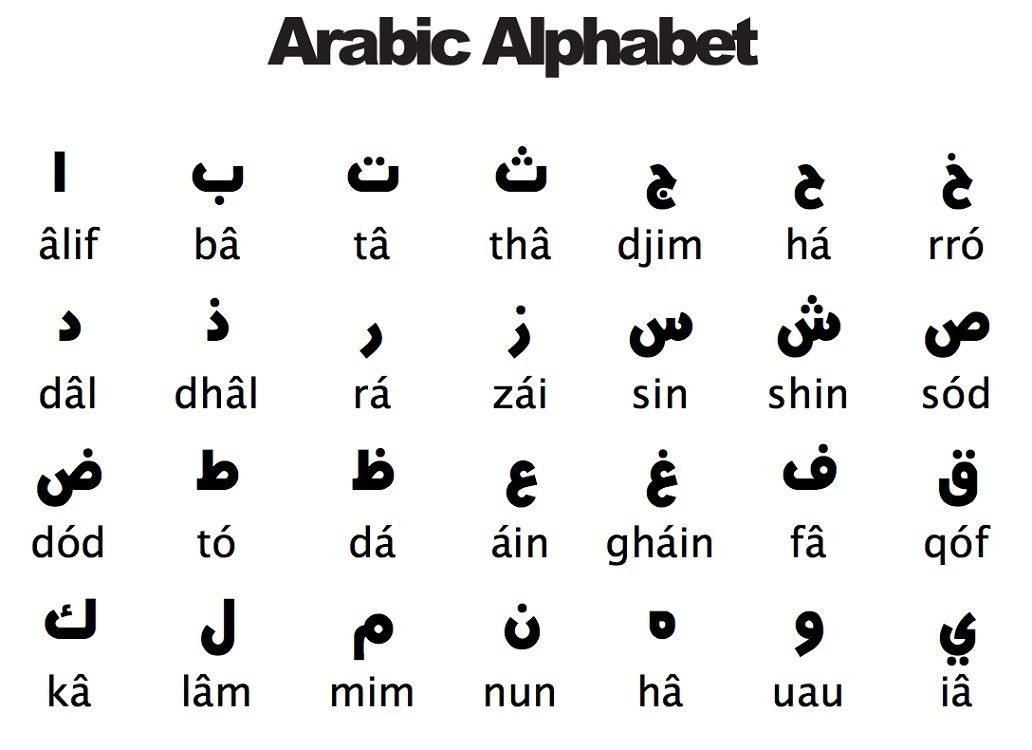
Alphabet in Arabic
About Arabic language
See more about Arabic language in here.
Arabic (اَلْعَرَبِيَّةُ, al-ʿarabiyyah [al ʕaraˈbijːa] (About this soundlisten) or عَرَبِيّ, ʿarabīy [ˈʕarabiː] (About this soundlisten) or [ʕaraˈbij]) is a Semitic language that first emerged in the 1st to 4th centuries CE. It is now the lingua franca of the Arab world. It is named after the Arabs, a term initially used to describe peoples living in the Arabian Peninsula bounded by eastern Egypt in the west, Mesopotamia in the east, and the Anti-Lebanon mountains and Northern Syria in the north, as perceived by ancient Greek geographers The ISO assigns language codes to thirty varieties of Arabic, including its standard form, Modern Standard Arabic, also referred to as Literary Arabic, which is modernized Classical Arabic. This distinction exists primarily among Western linguists; Arabic speakers themselves generally do not distinguish between Modern Standard Arabic and Classical Arabic, but rather refer to both as al-ʿarabiyyatu l-fuṣḥā (اَلعَرَبِيَّةُ ٱلْفُصْحَىٰ "the eloquent Arabic") or simply al-fuṣḥā (اَلْفُصْحَىٰ). Modern Standard Arabic is an official language of 26 states and 1 disputed territory, the third most after English and French..
Writing system in Arabic
Arabic Alphabet, Arabic Braille, Arabizi
Arabic Speaking Countries and Territories
Arabic Speaking Countries and Territories: Countries of the Arab League, minorities in neighboring countries and some parts of Asia, Africa, Europe..

Arabic native speakers
Arabic native speakers: 310 million, all varieties (2011–2016) 270 million L2 speakers of Standard (Modern) Arabic..
Arabic language code
Arabic language code is: ar-EG.
Conclusion on Fictions in Arabic
Now that you have learned and understood the common ways of saying Fictions in Arabic is "تخيلات", it's time to learn how to say Fictions in Arabic. This will hopefully give you a little motivation to study Arabic today.
تخيلات in Arabic meanings Fictions in English.