
Feelage in Arabic
Do you know Feelage in Arabic? How to use Feelage in Arabic and how to say Feelage in Arabic? How to write Feelage in Arabic? Now let's learn how to say Feelage in Arabic language.
Feelage translate to Arabic meanings: أشعر العمر.
In other words, أشعر العمر in Arabic is Feelage in English.Click to pronunce
| English | Arabic |

|
|
| Feelage | أشعر العمر |
How to use Feelage in Arabic?
Meaning of Feelage in Arabic language is: أشعر العمر.
Other words in Arabic
Frogmen, Funnier, Fraternising, Fibrinogeno, Fractionaldistillation,
Read more Synonyms and Antonyms of Feelage
Why we should learn Arabic language?
There are many, many reasons why learning a new language is a good idea. It allows you to communicate with new people. It helps you to see things from a different perspective, or get a deeper understanding of another culture. It helps you to become a better listener. It even has health benefits, as studies have shown that people who speak two or more languages have more active minds later in life!
7 reasons to learn a Arabic language
- Makes you smarter.
- Boosts academic achievement.
- Provides professional and career advantages.
- Provides broader access to education and information.
- Gives you more social and global skills.
- Increases national security.
- Life is more interesting.
How to say Feelage in Arabic?
أشعر العمر. This is your most common way to say Feelage in أشعر العمر language. Click audio icon to pronounce Feelage in Arabic::
| English | Arabic |
|
|
|
| Feelage | أشعر العمر |
How to write Feelage in Arabic?
The standard way to write "Feelage" in Arabic is: أشعر العمر
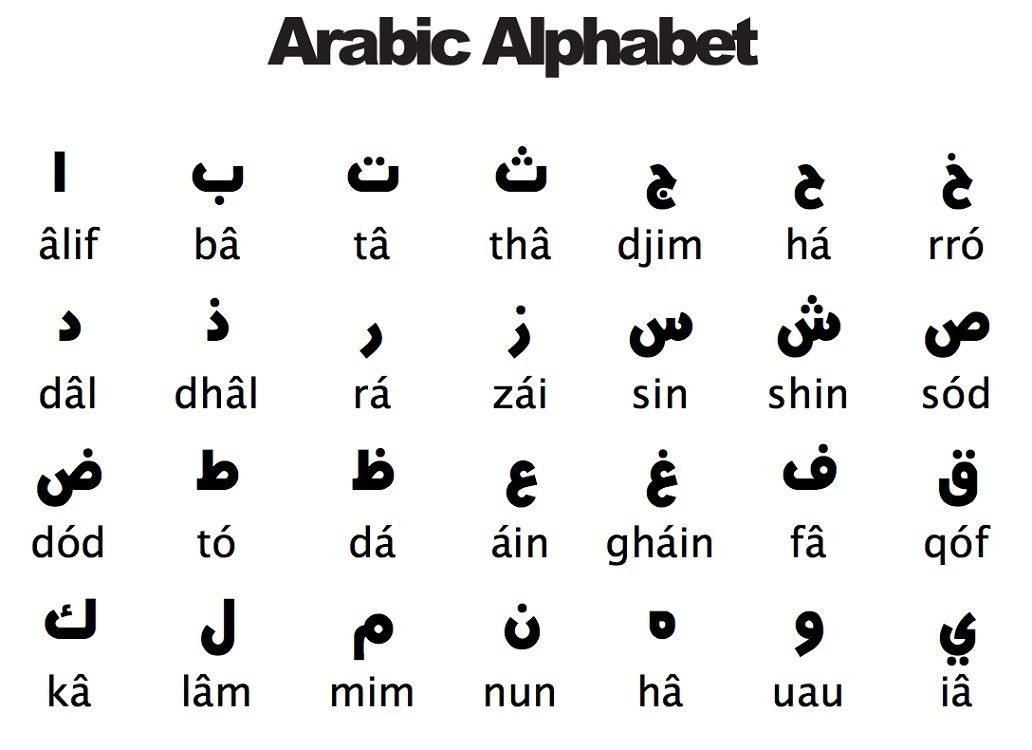
Alphabet in Arabic
About Arabic language
See more about Arabic language in here.
Arabic (اَلْعَرَبِيَّةُ, al-ʿarabiyyah [al ʕaraˈbijːa] (About this soundlisten) or عَرَبِيّ, ʿarabīy [ˈʕarabiː] (About this soundlisten) or [ʕaraˈbij]) is a Semitic language that first emerged in the 1st to 4th centuries CE. It is now the lingua franca of the Arab world. It is named after the Arabs, a term initially used to describe peoples living in the Arabian Peninsula bounded by eastern Egypt in the west, Mesopotamia in the east, and the Anti-Lebanon mountains and Northern Syria in the north, as perceived by ancient Greek geographers The ISO assigns language codes to thirty varieties of Arabic, including its standard form, Modern Standard Arabic, also referred to as Literary Arabic, which is modernized Classical Arabic. This distinction exists primarily among Western linguists; Arabic speakers themselves generally do not distinguish between Modern Standard Arabic and Classical Arabic, but rather refer to both as al-ʿarabiyyatu l-fuṣḥā (اَلعَرَبِيَّةُ ٱلْفُصْحَىٰ "the eloquent Arabic") or simply al-fuṣḥā (اَلْفُصْحَىٰ). Modern Standard Arabic is an official language of 26 states and 1 disputed territory, the third most after English and French..
Writing system in Arabic
Arabic Alphabet, Arabic Braille, Arabizi
Arabic Speaking Countries and Territories
Arabic Speaking Countries and Territories: Countries of the Arab League, minorities in neighboring countries and some parts of Asia, Africa, Europe..

Arabic native speakers
Arabic native speakers: 310 million, all varieties (2011–2016) 270 million L2 speakers of Standard (Modern) Arabic..
Arabic language code
Arabic language code is: ar-EG.
Conclusion on Feelage in Arabic
Now that you have learned and understood the common ways of saying Feelage in Arabic is "أشعر العمر", it's time to learn how to say Feelage in Arabic. This will hopefully give you a little motivation to study Arabic today.
أشعر العمر in Arabic meanings Feelage in English.